

Welcome to the LQDTY Chain Loan Servicing API
Overview
The LQDTY Chain offers a decentralized, transparent, and programmable infrastructure for managing the complete lifecycle of digital loans. Designed for financial institutions, fintechs, and service providers, this API enables secure interactions across various stages of a loan — from application to repayment and beyond. Our loan servicing protocol is powered by smart contracts and NFT-based representations, ensuring automation, auditability, and compliance across all participants.What You Can Do with This API
With this suite of APIs, developers can:- Submit and manage digital loan applications
- Trigger and track underwriting, document verification, and approval workflows
- Request and validate collateral
- Disburse funds securely on-chain
- Monitor repayment schedules and default events
- Access borrower communications and servicer notices
- Securely store and fetch off-chain PII and financial data
The Loan Lifecycle on LQDTY
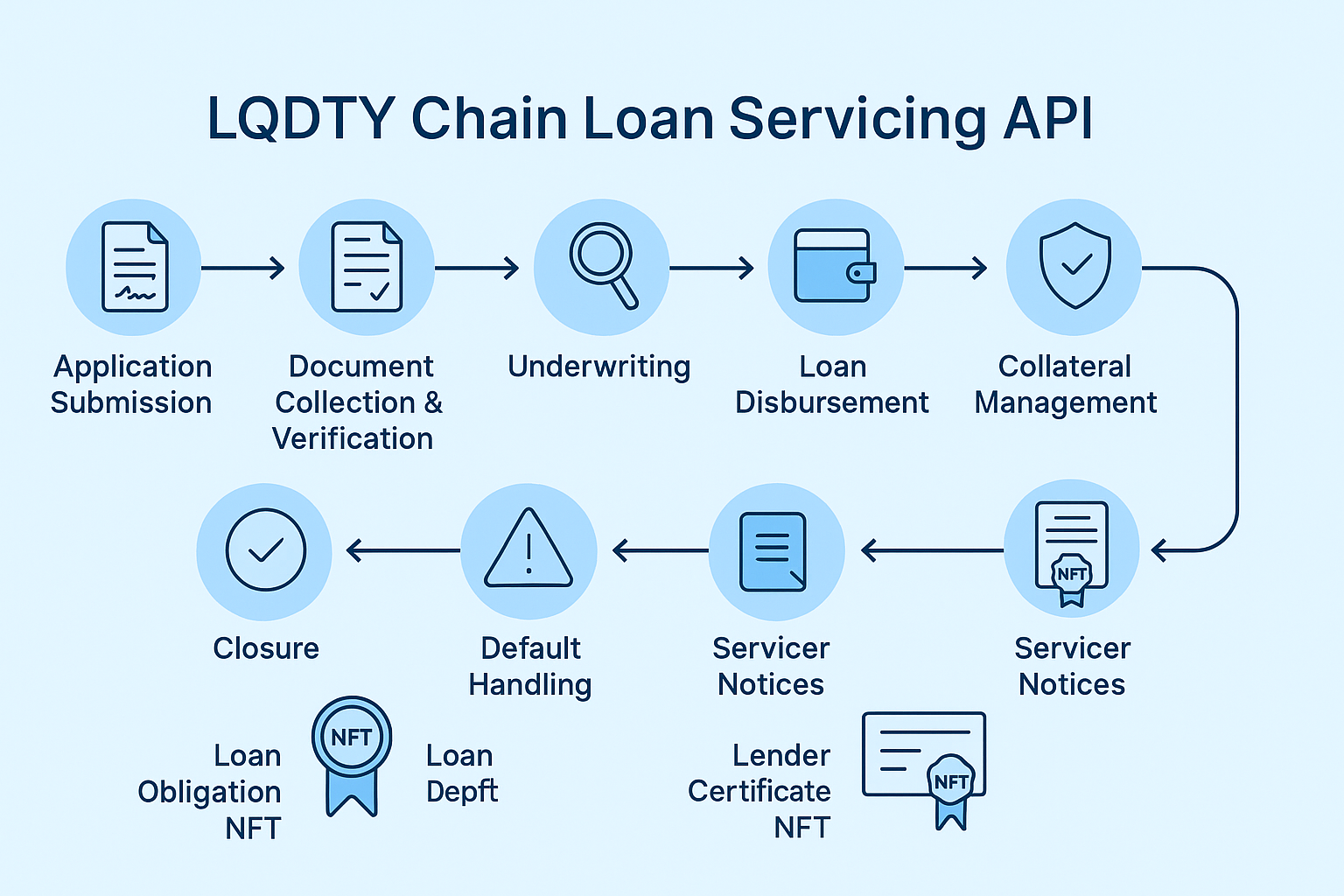
Each loan progresses through a well-defined set of on-chain states:- Application Submission → Borrower initiates the process
- Document Collection & Verification → For due diligence
- Underwriting → Risk and terms assessment
- Collateral Management → Request, deposit, and approve
- Loan Disbursement → Funds are released on-chain
- Repayment Initiation & Tracking → Repayment schedule begins
- Closure / Default Handling → Based on repayment performance
NFT-Based Loan Representation
The LQDTY protocol uses two non-fungible tokens (NFTs) to represent loan positions:- Loan Obligation NFT: Non-transferable, issued to the borrower as a digital representation of the loan agreement and repayment responsibility.
- Lender Certificate NFT: Transferable, issued to the lender and representing rights to future cash flows — enabling secondary market trades or securitization.
Data Architecture
Our system separates loan data into three categories:- On-Chain: Loan state, principal, interest, repayment status, NFTs, and lifecycle transitions
- Off-Chain (Non-PII): Metadata, repayment history, contract terms (hashed or plaintext)
- Off-Chain (PII): Borrower details, contact information, employment history — encrypted and securely stored
Key Features
- 📄 Role-Based Access: Granular control for lenders, servicers, and borrowers
- 🔐 Secure PII Handling: PII is encrypted using Bearer-token access
- 🔁 Programmable Workflows: Every loan stage can be advanced via API calls
- 📊 Verifiable On-Chain State: Lifecycle states are tamper-proof and audit-friendly
- 🛠️ Developer Friendly: Consistent endpoint design and payload schemas
Start Exploring
Powering secure, transparent, and programmable lending for the digital economy.